What is the deep web?
The deep web refers to any part of the internet that isn’t publicly accessible through search engines. Instead of being indexed and searchable, this content is protected behind logins, paywalls, or other access controls, meaning only authorized users can view it.
This includes everyday services you likely use daily, such as email accounts, online banking portals, private social media content, subscription platforms, and workplace tools. These pages are intentionally hidden from search results to protect sensitive information and user privacy.
Far from being suspicious, the deep web is a normal and essential part of how the internet works. In fact, most of the internet exists beneath the surface, supporting secure, personalized experiences that wouldn’t be possible if everything were publicly visible.
Common uses of the deep web
The deep web is used for many everyday online activities — from checking your email to managing your bank account. In fact, much of our daily internet use happens there.
Here are a few common examples of services that exist on the deep web:
-
Email inboxes and private messages: Email and messaging platforms store personal and professional conversations, attachments, and notifications.
-
Online banking services: Banking apps and payment services let you check balances, transfer funds, and review transactions.
-
Subscription platforms and paywalled content: Streaming services, news sites, and other subscription platforms provide content only to paying users.
-
Social media accounts and private groups: Beyond public posts, social platforms host private profiles, direct messages, and members-only groups.
-
Business tools: Workplace platforms like Slack and Asana support team communication, project tracking, and collaboration.
-
Cloud storage services: Cloud services like Dropbox or Google Drive let you store, organize, and share files online.
-
Healthcare portals and medical records: Patient portals give you secure access to medical information such as test results, prescriptions, and appointment details.
What is the dark web?
The dark web is a hidden part of the internet that requires special software, such as the Tor browser, to access. Like the deep web, dark web sites aren’t indexed by search engines like Google or Bing, and user identities are intentionally obscured to support anonymous browsing.
Because of this anonymity, the dark web is often associated with illegal activity, including the sale of illicit goods and stolen data. However, it’s not inherently illegal or entirely harmful. The dark web is also used by journalists, activists, and everyday users who need privacy — especially in countries with strict censorship or surveillance.
That said, it comes with significant risks. Dark web websites aren’t regulated, and there’s little accountability if something goes wrong. Without the safeguards you’re used to on the regular web, you’re more likely to encounter scams, malware, or disturbing and illegal content.
Common uses of the dark web
The dark web is often associated with illegal activity — and for good reason. Studies estimate that a significant portion of dark web content (about 57%, according to DeepStrike) is linked to illegal activity, including illicit marketplaces trading drugs, illegal content, stolen data, and malware.
However, not everything on the dark web is illegal, and simply accessing it isn’t against the law in most countries.
Here are some of the most common uses of the dark web, both legal and illegal:
Legal activity

Privacy and anonymity: Individuals use it to browse and communicate without tracking, especially in regions with limited privacy protections.
-
Journalism and whistleblowing: Secure platforms allow sources to share sensitive information with journalists anonymously.
-
Bypassing censorship: Users in restrictive countries access blocked news sites, social platforms, and information.
-
Secure communication: Activists, researchers, and organizations use encrypted services to protect sensitive discussions.
-
Research and cybersecurity: Security professionals monitor dark web activity to track threats, study cybercrime trends, and identify leaked data.
Illegal activity

Drug trafficking: Online marketplaces facilitate the sale and distribution of illegal drugs, often using cryptocurrency for anonymity.
-
Stolen data trading: Personal information from data breaches, such as login credentials, credit card numbers, and identity documents, is bought and sold.
-
Malware and hacking services: Cybercriminals offer ransomware, phishing kits, and hacking-for-hire services targeting individuals and organizations.
-
Illegal firearms sales: Some marketplaces list weapons and related items, often bypassing standard regulations.
-
Fraud and financial scams: Activities include selling counterfeit documents, running investment scams, and offering tools for financial fraud.
If you’re concerned about your personal information appearing in illicit marketplaces, dark web monitoring alerts give you a chance to act before it’s misused. AVG BreachGuard continuously scans for exposed data and notifies you of potential risks, helping you secure your accounts early and reduce the likelihood of identity theft.
Deep web vs. dark web: key differences
The dark web is technically a subset of the deep web because its pages aren’t indexed by standard search engines. But the reverse isn’t true: most of the deep web is not part of the dark web. While hidden from public view, the deep web is mostly made up of everyday content such as email inboxes, online banking accounts, subscription services, and private databases, and shares the same infrastructure as the surface web.
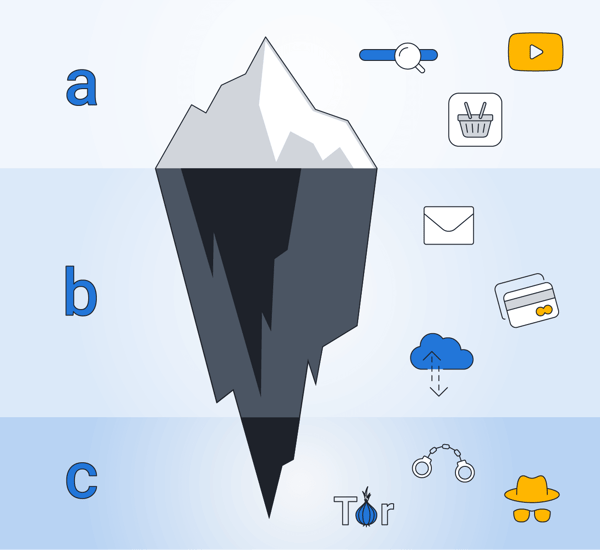 A: The surface web includes publicly accessible and searchable websites.
B: The deep web consists of content behind logins or access controls.
C: The dark web is non-indexed and unreachable through standard browsers.
The dark web, by contrast, consists of deliberately hidden sites that aren’t accessible through standard browsers or traditional links. It operates on specialized networks called darknets, which use layered encryption to obscure user identities and route traffic, and require dedicated tools like the Tor browser to access.
Accessibility and anonymity
The deep web and dark web differ significantly in both how you access them and how anonymous you are while using them.
The deep web is straightforward to access. You use a standard browser — Chrome, Safari, or Firefox — and log in to sites like your email, bank account, or social media. Although this content isn’t indexed by search engines, your activity isn’t anonymous. Websites, service providers, and advertisers can still track your behavior unless you take additional steps, such as using a VPN or adjusting privacy-focused browser settings.
The dark web, by contrast, requires specialized software to reach. The most common tool is the Tor browser, which enables access to websites that use the “.onion” domain, which aren’t available through regular browsers. In doing so, it also helps anonymize your connection by routing your traffic through multiple encrypted layers to help obscure your identity and location.
Legal vs. illegal activities
The deep web is primarily used for legal, everyday activities, while the dark web is more often associated with illegal content and cybercrime. That said, neither is inherently “good” or “bad” — it depends on how they’re used. People are scammed on the deep web every day, and many dark web sites support legitimate activities such as journalism, whistleblowing, and private communication.
In most countries, accessing both the deep web and the dark web is legal. Tools like the Tor browser are designed to enhance privacy and are widely used for lawful purposes. However, some governments restrict or monitor Tor and similar tools — particularly in countries with strict internet censorship, such as China, Iran, and Russia.
The key point is this: legality depends on what you do online, not the network or technology you use. If you engage in illegal activity, such as buying stolen data or distributing malware, it’s a crime regardless of whether it occurs on the surface web, deep web, or dark web.
Examples of deep web and dark web sites
Deep web examples include email services, online banking portals, subscription platforms, and private workplace tools. Dark web sites, by contrast, include anonymous forums, whistleblowing platforms, and hidden marketplaces, some of which are used for illegal activities.
Some deep web examples include:
Here are some safe-to-visit dark web examples:
-
The CIA’s .onion site for submitting anonymous threat reports
-
The Hidden Wiki, a directory of dark web sites
-
ProPublica, an investigative journalism platform
-
SecureDrop, an anonymous file-sharing service
-
Riseup, a provider of privacy-focused tools for activists
Risks of accessing the deep web and dark web
The deep web may feel safer than the dark web, but it still contains vast amounts of sensitive data. If one of your deep web portals (such as your email or bank account) is compromised in a security breach, that data can be exposed and used for fraud or identity theft.
And while the deep web is private, it’s not anonymous. Your activity can still be tracked by websites, service providers, and advertisers — especially if you’re not using tools like a VPN or privacy-focused browser settings.
The dark web, on the other hand, presents a different set of risks. It operates in a largely unregulated environment where scams, malware, and phishing attacks are common, and there’s little recourse if something goes wrong. And although it’s designed to enhance anonymity, it doesn’t make your activity impossible to trace altogether.
How to protect your data on the deep and dark web
Cybercrime isn’t confined to the dark web — it affects everyday internet use. The majority of adults have encountered some form of cybercrime, many without ever visiting the dark web. In fact, cybercriminals often extract information from deep web databases, accounts, or breaches, then sell it on dark web marketplaces.
Protecting yourself requires a combination of smart everyday security practices and awareness of how your data may be exposed. Securing your deep web accounts helps prevent breaches, while monitoring tools can alert you if your information appears in known leak databases or underground markets.
Here are practical steps to protect your data and devices:
-
Enable multi-factor authentication (MFA) on all accounts.
-
Use strong, unique passwords for every account.
-
Store passwords securely with a password manager.
-
Use reputable antivirus or security software with breach monitoring features.
-
Regularly scan your device for malware — especially if you access higher-risk sites.
-
Update your apps, operating system, and browser regularly.
-
Avoid clicking unknown links or downloading untrusted files.
-
Don’t access sensitive accounts on public Wi-Fi without a VPN.
-
Use breach detection and dark web monitoring tools like AVG BreachGuard to stay ahead of identity threats.
Protect your privacy with AVG Secure VPN
The deep web and dark web expose your data in different ways — from stored personal information to potential misuse if it’s leaked or accessed in risky environments. Staying protected means reducing how much of your activity and identity is visible online in the first place.
AVG Secure VPN helps by encrypting your connection and masking your IP address, making it harder for third parties to track your activity or intercept your data. Whether you’re browsing everyday sites or exploring less visible parts of the internet, it adds a simple, reliable layer of privacy.