What is VoIP?
VoIP stands for Voice over Internet Protocol. This technology enables voice communication via any internet-connected device, as opposed to exclusively through a phone. It works by converting voice audio into digital data packets, meaning it can be transmitted across the internet to any receiving device. ⚙︎
VoIP is a low-cost form of communication that also allows for multimedia calls and instant messaging, offering more flexibility and functionality than a call on a traditional phone line.
There are two types of VoIP systems: hardware based and software based.
-
Hardware-based VoIP phones, which look like a traditional landline phone but connect to an internet modem to make calls.
-
Software-based VoIP systems, which are apps that allow computer, tablet, and smartphone users to make and receive calls, relying on speakers and microphones for audio transmission.
Companies such as AT&T, Verizon and T-Mobile offer hardware-based VoIP systems, while popular examples of VoIP software include Zoom, WhatsApp, and the now-defunct Skype.
VoIP phones are a popular option for businesses, who may benefit from the ability to use the same number across multiple devices or engage in group calls. They’re particularly useful for remote or hybrid working teams, or businesses who have long-distance client relationships.
How does VoIP work?
VoIP phone systems work by converting the speakers’ voices into digital data packets, which are then sent via an internet protocol (IP) network. When the data reaches the destination (the other device on the call), these data packets are converted back into audio.
And all of this happens almost instantly: from a user’s perspective, there’s no difference to using a traditional phone line. That means VoIP systems are easy to use on both computers and mobile devices.
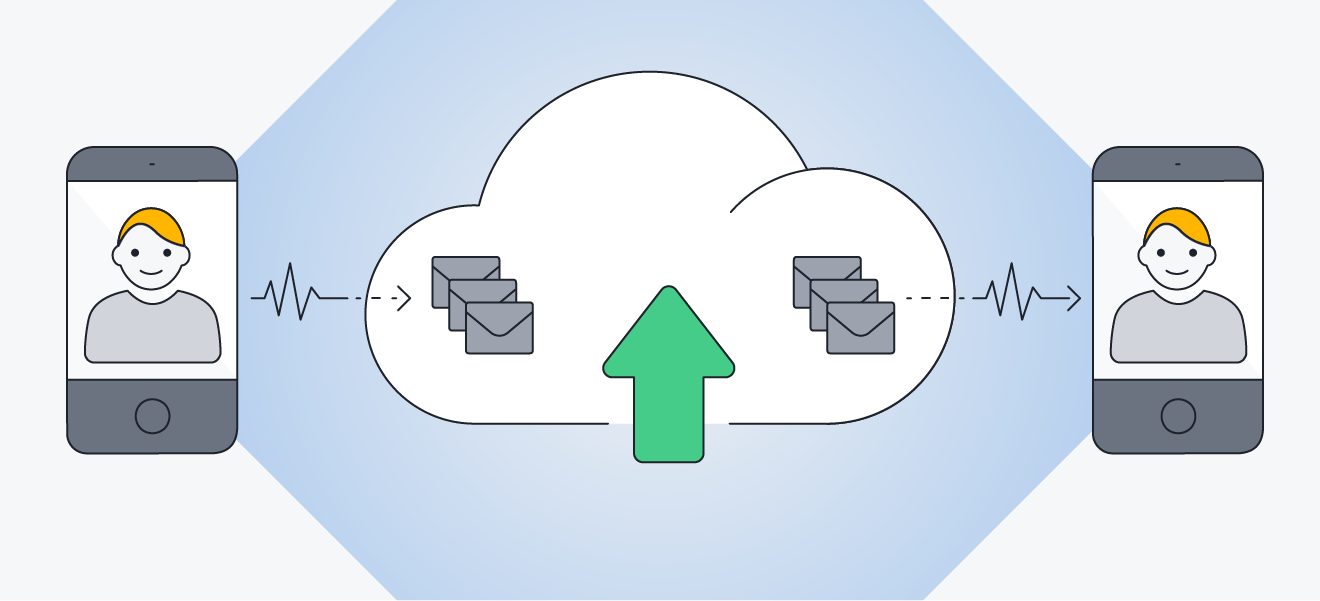 VoIP turns speech into digital packets, sends them online, then rebuilds them as clear voice.
VoIP vs. traditional landlines
Traditional landlines allow you to make voice calls from a home phone line, whereas VoIP systems facilitate voice calls, video calls, and instant messages from a VoIP phone, desktop computers, laptops, smartphones, and other digital devices.
Here’s a summary of some of the main differences between VoIP and traditional landline technology:
| |
VoIP |
Landline |
| Technology |
Analog sound waves are converted into digital data packages and transmitted via the internet. |
Analog sound waves travel as an electrical signal via copper wiring or are digitized and sent via fiber-optic cables. |
| Features |
Voice call, video call, instant messaging, call forwarding, integration with other apps. |
Basic voice calling. |
| Call quality |
Generally higher but relies on a fast and stable internet connection. |
Generally stable and consistent. |
| Reliability |
Requires an internet connection and is susceptible to power outages and router issues. |
May still work during power outages. |
| Cost |
Typically lower monthly cost than a phone bill. |
Higher cost, particularly for long distance or international calls. |
| Security |
Uses encryption to protect against interception and other cyberattacks. |
Lacks encryption and is potentially susceptible to physical wiretaps, but hard to hack remotely. |
What are SIP and PBX?
SIP, or Session Initiation Protocol, and PBX, or Private Branch Exchange, are two integral parts of VoIP. SIP links the caller’s device to the central VoIP server, which is what enables users to make VoIP calls. PBX is essentially a private phone network within a business that manages all internal and external calls. This means businesses do not have to purchase additional phone lines, keeping costs down.
What are the pros of VoIP?
VoIP has several advantages, such as being low cost and easy to use across multiple devices. Here’s a more detailed look at the main pros of VoIP technology.
 Cost saving
VoIP services are generally significantly cheaper than landline services. A VoIP service such as Google Voice offers plans starting at $10 per month with unlimited local calls, or from $30 per month with unlimited international calls. In comparison, a basic AT&T landline plan with unlimited local calls starts at $58 per month, with an additional $15 for unlimited international calls.
Assuming they are not included in the purchase plan, international calls are significantly cheaper for VoIP services. Using a VoIP service like Google Voice, for example, a 10-minute phone call from the U.S. to France would cost around $0.10, whereas a landline provider such as AT&T would charge $30 for the same 10-minute phone call at pay-per-minute rates.
Enhanced call quality worldwide
Assuming a strong and stable internet connection, VoIP services provide high call quality without static or interference anywhere in the world. While landline phones generally have high call quality locally, performance may drop as the distance between the two parties on the call increases.
Robust security
VoIP technologies generally use encryption protocols to keep calls secure and private. TLS (Transport Layer Security) secures the call’s signaling, including phone numbers and caller IDs, while SRTP (Secure Real-Time Transport Protocol) encrypts the audio and video data.
Using a virtual private network (VPN) can add an additional layer of security by keeping the caller’s activities private and their personal information secure, even when connected to public WiFi.
Additional features
VoIP has additional useful features, including the ability to answer and make calls anywhere with a mobile device, rather than being tied to a home-based landline. It can also integrate several apps into a single platform. This enables users to voice call, video call, screen share, and send secure instant messages.
What are the disadvantages of VoIP?
VoIP does have its drawbacks, including its dependency on a fast and stable internet connection in order to function properly. Let’s look at the cons of VoIP in more detail.
 Unable to access your location
Unlike traditional landlines, which are tied to a physical line at a known street address, VoIP systems work anywhere there’s internet. Because a VoIP number isn’t associated with a permanent location, VoIP providers can’t automatically determine where you are if you dial 911.
Accordingly, many VoIP services offer (and sometimes require) the payment of an E911 fee to ensure emergency services can locate you in case of emergency.
Not available during power outages
Since VoIP services rely on an internet connection, they are not available during a power outage. However, users with a cloud PBX provider can forward calls to a mobile during a power outage, allowing them to receive calls.
High internet speeds required
VoIP services require at least 100kbps of bandwidth to make clear, high-quality calls. Slower internet connections might cause calls to lag or drop. You can perform a speed test to check if your internet speed will support VoIP services.
What equipment is needed for VoIP?
Most people will already own all the equipment needed for VoIP, making setup cheap and easy for the majority of users. Here’s a breakdown of what’s needed, although only the first two are essential:
-
Internet connection: VoIP requires a stable internet connection, which can be delivered via a home Wi-Fi network or mobile data package. If you’re using the former, investing in a good router should help boost performance, as slower internet speeds can compromise call quality.
-
Calling device: You’ll need a device capable of making a call, which could be a VoIP-enabled deskphone, smartphone, computer, or even a tablet.
-
ATA or IP phone: You can use an Analog Telephone Adapter to make an analog landline phone VoIP compatible, or get an IP phone to replace your older hardware.
-
Headset and microphone: Optionally, you can purchase a headset or additional microphone for superior call quality, although most devices include built-in options.
Are VoIP calls free?
Free or low-cost VoIP services are available via platforms such as Zoom and Google Meet, and many landline service providers also offer VoIP setup for home phones for no additional cost, although others may require an installation or upgrade fee.
Businesses may incur additional fees such as number porting fees and regulatory fees for adding additional numbers to their VoIP service.
Keep your online communication private with AVG Secure VPN
Whether you’re making VoIP calls at home or on a public Wi-Fi network, or on a desktop computer or mobile device, AVG Secure VPN can help strengthen your privacy and security. It adds an extra layer of encryption to hide your online activities from prying eyes and keep your in-transit data protected.
FAQs
Can VoIPs be used with analog phones?
With the help of an ATA (Analog Telephone Adapter), it is possible to use a VoIP service on an analog phone. ATAs work by turning analog signals into digital data packets, making older analog phones VoIP compatible.
Can VoIP replace other phone types?
Many landlines are compatible with or can be replaced by VoIP technologies. Check with your local provider to see if it is possible to replace your landline with a VoIP alternative. In most cases, you’ll need to replace your deskphone with an IP phone or use an ATA adaptor to make the existing landline phone VoIP compatible.
How is VoIP monitored?
VoIP is monitored by the FCC (Federal Communications Commission), which regulates all domestic and international communications in the U.S. via radio, TV, wire, satellite and cable and enforces U.S. communications law and regulations per the Communications Act (1934). The Communications Assistance for Law Enforcement Act (1994) requires VoIP systems to allow law enforcement to perform surveillance with a warrant. VoIP is also protected by privacy and data protection rules to restrict how providers can share customer call data.