Understanding brute force attacks
A brute force attack is like pounding on a locked door until it finally gives way — sheer persistence may eventually pay off over finesse. Hackers employing this form of attack use trial and error to guess passwords, decrypt sensitive data, or break into protected systems, websites, or networks.
For instance, an attacker might begin with common words or personal details (say, your first pet’s name: Fluffy) and then test variations with numbers or symbols until they hit the right combination (Fluffy123).
Although brute force is one of the oldest tricks in the hacking playbook, it remains alarmingly effective. Modern attackers supercharge the process using specialized tools like Hashcat, allowing them to test millions of password combinations in seconds.
These attacks succeed most often against weak or reused passwords. That’s why strong, unique credentials — and layered protections — are your best defense.
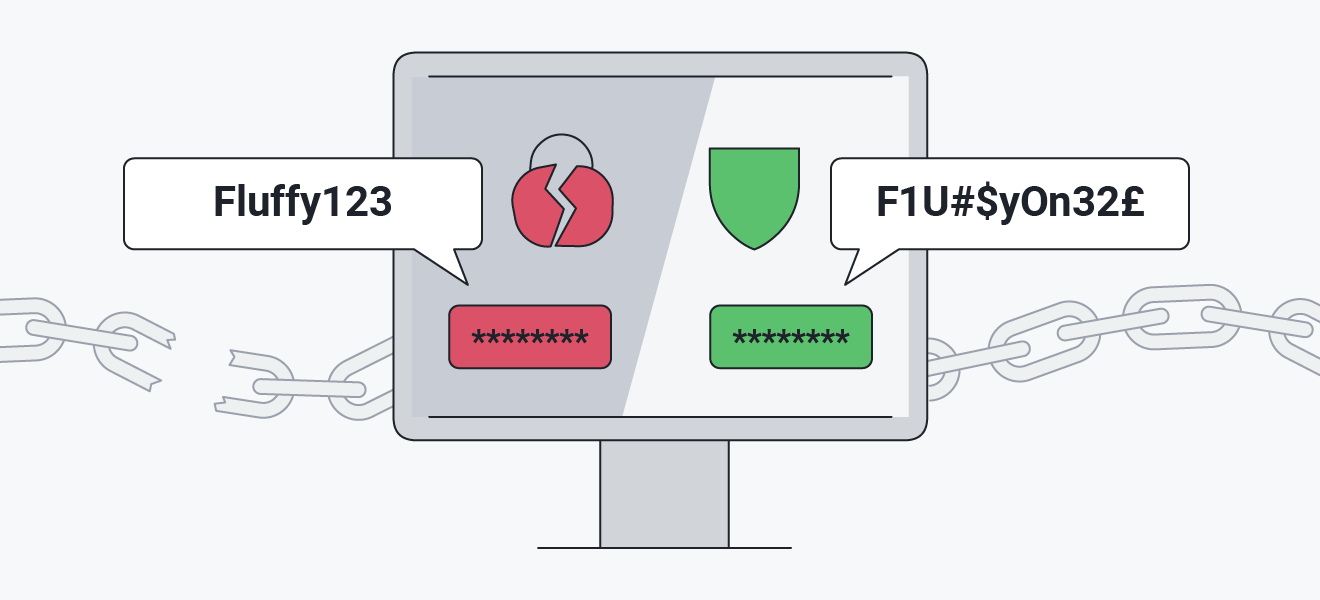 Passwords with a mix of characters — lower-case and upper-case letters, symbols, and numbers — are harder for hackers to crack.
Types of brute force attacks
The term comes from the fact that attackers rely on the sheer force of rapid-fire attempts to break into systems and steal sensitive data. It’s one of the most common forms of password-cracking, and hackers employ several variations of the attack.
 Simple brute force attacks
Requirements: Time, persistence, and weak passwords.
In a simple brute force attack, a hacker manually and systematically attempts to guess a user’s login credentials without relying on automated tools. It’s the digital equivalent of trying every key on a massive keyring until one fits the lock.
Attackers usually begin with the most obvious and common choices, like “1234,” “qwerty,” or “password123.” Some may even do light research, such as scanning social media for personal details (a pet’s name, a birthday, or a mother’s maiden name) to make more informed guesses.
The most effective defense is using long, complex, and unique passwords. By dramatically increasing the number of possible combinations, these passwords make brute force attempts slow, impractical, and rarely worth the effort. In contrast, short or predictable passwords are easy targets, offering hackers a quick win.
 Dictionary attacks
Requirements: Precompiled word lists, time, and weak passwords.
Unlike a pure brute force attack that tries every possible combination, a dictionary attack relies on precompiled lists of words and variations commonly used as passwords. Think of it as flipping through a dictionary — testing one entry after another until the right one unlocks the account.
Attackers often enhance these lists with predictable variations, such as swapping letters for numbers or adding special characters. While it requires more thought than brute force alone, it’s often combined with brute force methods to speed up the guessing process.
Dictionary attacks are slower and less effective against strong, unique passphrases. If your password doesn’t appear in common word lists and isn’t tied to personal information (like pet names or birthdays), attackers using this method are far less likely to succeed.
 Hybrid brute force attacks
Requirements: Precompiled word lists, time, and predictable passwords.
A hybrid brute force attack blends the methods of a dictionary attack with the persistence of pure brute force. Hackers typically begin with a known username, then run through a dictionary of likely words (like names, phrases, or locations), and finish by appending predictable combinations of numbers, dates, or symbols.
Common techniques include:
-
Taking a dictionary word like “password” and altering it slightly to create “p@sswOrd.”
-
Combining words with numbers or symbols, such as “Youaremine2023.”
-
Recycling passwords leaked in data breaches to see if they still work across other accounts.
By mixing guesswork with pattern recognition, this method can break passwords that are too complex for simple dictionary attacks, yet too predictable to resist brute force. Passwords that mash real words with obvious add-ons are especially vulnerable.
 Reverse brute force attacks
Requirements: Lists of user accounts and reused passwords.
A reverse brute force attack flips the traditional method. Instead of hammering one username with endless password guesses, attackers take a single weak password, like “123456” or “password,” and test it across a massive list of usernames. With enough accounts, the odds are high that at least someone will be using the selected password.
Hackers often rely on data breaches for these username lists. Breached databases can contain thousands (or even millions) of accounts, giving attackers ample opportunity to strike. The danger multiplies when people reuse the same weak password across multiple platforms. One compromised login can cascade into multiple account takeovers, like a row of dominoes falling.
 Credential stuffing
Requirements: Stolen credentials and reused passwords.
Credential stuffing is a streamlined, automated attack that preys on people who reuse the same login credentials across multiple accounts. Instead of guessing passwords, hackers take stolen usernames and passwords — often leaked in data breaches — and “stuff” them into other sites and apps to see where else they work.
Because so many users recycle credentials, this sneaky twist on brute force attacks is both fast and highly effective. Attackers use bots to test thousands of login combinations in minutes, often slipping past basic security systems undetected.
Strong passwords are kryptonite to brute force attacks, and managing them is much easier with the right tool. AVG BreachGuard comes with a built-in password manager and secure vault to protect your logins, while syncing them across all your devices. Not only does it help shield you from cyberattacks, but it also spares you from dealing with password reset emails.
Common goals of brute force attacks
There are many reasons why hackers target computer systems and databases in brute force attacks. They’re usually chasing easy money or want to cause panic and disruption. Others are driven by their egos.
Stealing personal data
By cracking passwords, attackers can access sensitive details like emails, addresses, financial records, and ID numbers. This information is highly valuable for identity theft, resale on the dark web, or launching wider attacks. Corporate breaches are especially lucrative, giving hackers access to large databases of customer and business data.
Financial gain
The endgame is often profit. Once inside, attackers may drain bank accounts, exploit payment systems, or commit fraud using stolen credentials. Some also hijack websites with spam ads to collect advertising revenue or sell victims’ browsing data to marketers.
Spreading malware
Breached systems may be used to deploy malware, ransomware, or backdoors for larger attacks via spoofed emails, text messages, or fake websites designed to mimic legitimate ones. In some cases, the motive is simply chaos, or it could be to test skills or prove capability.
Damaging a company’s reputation
Leaked customer data, downtime, public exposure… A successful brute force attack is a PR nightmare and can have serious consequences for companies. It’s an ideal weapon for hackers looking to erode credibility and damage a brand’s image.
Brute force attacks in action
As with any cyberattack, no one is immune. In 2018, a brute force attack compromised the Northern Irish Parliament when cybercriminals hacked assembly members’ email accounts by repeatedly guessing passwords. They accessed confidential data and even deleted accounts, causing significant disruption.
Even the biggest online players aren’t untouchable. In 2016, Alibaba fell victim to a brute force attack that exposed the usernames and passwords of 99 million users. And the threat is only growing. According to the 2024 Elastic Global Threat Report, brute force techniques rose by 12% over the past year, accounting for nearly 35% of all attack methods in Microsoft Azure.
Tools and technologies used in brute force attacks
Brute force attacks are no longer just about endless, mindless guessing. Modern hackers have refined their methods, combining strategy with sophisticated tools to make the process faster, smarter, and far more dangerous.
Popular programs like Aircrack-ng, John the Ripper, and Hashcat automate the trial-and-error process at incredible speeds. These tools can blast through massive lists of passwords and even test complex combinations that would take humans centuries to guess manually. Automation removes the limits of patience and scale, letting attackers operate like digital supervillains.
But these cutting-edge brute force attacks require enormous computing power. To accelerate them, hackers combine the raw muscle of CPUs with the parallel processing strength of GPUs. GPUs — originally built for graphics-heavy tasks like gaming or video rendering — can process thousands of password guesses simultaneously. This hybrid setup dramatically reduces the time needed to break into accounts.
With automation layered on top of GPU power, brute force attacks have shifted from slow, manual work into organized, large-scale assaults. Hackers can now target countless accounts at once, grinding weak passwords to dust.
And brute force attacks are just one example of how cybercrime is evolving into a faster, more efficient beast. Every day, attackers are innovating — there are now an estimated 190,000 new malware attacks every second.
How to help stop brute force attacks
Brute force attacks rely on persistence, but the right defenses can stop them in their tracks. Here’s how to help keep your accounts and data locked up tight:
-
Create complex passwords: Choose unique and strong passwords with at least 15 randomized characters, ideally more.
-
Use a passphrase: Better yet, use passphrases — memorable phrases strung together that are easier to recall but much harder to crack. Avoid common choices or anything tied to you personally, like your favorite team or birthplace.
-
Use a password manager: A password manager generates strong, unique passwords and stores them securely in an encrypted vault. With auto-fill and device sync, it also makes everyday logins faster and safer.
-
Use 2FA or MFA: Two-factor authentication (2FA) or multi-factor authentication (MFA) adds an extra lock to your accounts. Whether it’s a one-time SMS code, an authenticator app, or a fingerprint scan, this extra step keeps attackers out even if they guess your password.
-
Limit login attempts and use CAPTCHA: Restricting login attempts and adding CAPTCHA makes it much harder for automated bots to brute-force their way into accounts.
-
Protect data with salting and hashing: Hashing transforms a password into an irreversible string of characters, while salting adds a random, unique element before hashing. Together, they make stolen data far more resistant to decryption.
-
Monitor accounts for suspicious activity: Set up alerts or monitoring for unusual logins, failed attempts, or unexpected transactions. Spotting red flags early can help you stop brute force attempts before they cause damage.
Help prevent brute force attacks with AVG BreachGuard
From password management to real-time monitoring and analysis, AVG BreachGuard helps protect your sensitive data from brute force attacks and other cyberthreats. As well as creating and storing strong, unique logins, it continually scans the internet for exposed personal data, possibly alerting you to leaks before criminals can exploit them. Take charge of your online security today.














/Signal-Have-you-been-hacked-and-what-to-do-about-it-Thumb.jpg)
%20-%20refresh/The_Most_Dangerous_and_Famous_Hackers_Today-Thumb-refresh.jpg)


/How-to-prevent-router-hacking-Thumb.jpg)


