What is Booking.com and how does it work?
Booking.com is an online travel agency (OTA) that helps users book hotels, flights, vacation rentals, car rentals, and other travel services. Travelers simply enter their destination and travel dates to compare prices, browse reviews, and reserve accommodations or transportation directly through the platform.
Booking.com does not own the properties or vehicles listed on its platform. Instead, it acts as an aggregator, connecting users with third-party providers ranging from major hotel chains and airlines to private hosts renting out spare rooms or vacation homes. With over 31 million listings, Booking.com offers one of the largest accommodation selections online.
To make a booking, enter your travel details on the homepage and browse available results. You can filter listings by price, location, amenities, and other preferences to narrow down your options. Once you select a property or service, enter your information and confirm the reservation.
After making a booking, you’ll receive a confirmation email with your reservation details. Be sure to keep this confirmation, as it may be important if you need to resolve disputes or verify your booking later.
Is Booking.com safe?
Yes, Booking.com is a generally safe and legitimate company owned by Booking Holdings, the world’s largest online travel agency. Millions of travelers use the platform every year to book hotels, flights, car rentals, and vacation homes. However, like many major travel platforms, scammers sometimes exploit its popularity to target users with fake listings and phishing scams.
Booking.com operates as a marketplace connecting travellers with third-party hosts and businesses, so travellers face an increased risk of scams and fraud. While the company works to remove fake listings and block scammers, Booking.com scams appear to be growing. Reports of Booking-related fraud surged by as much as 900% in 2024 , and consumer surveys found that many customers received suspicious or scam messages that appeared to come through official Booking channels.
In early 2026, Booking.com was exploited in what AVG’s parent company, Gen, is calling a Reservation Hijack scam. Attackers reportedly gained access to a hotel management platform, Cloudbeds, by phishing hotel staff credentials. Using information from legitimate reservations, the scammers then impersonated hotels and guest relations teams through WhatsApp, email, and text messages. The goal was to trick real customers into making fraudulent payments or revealing valid payment information.
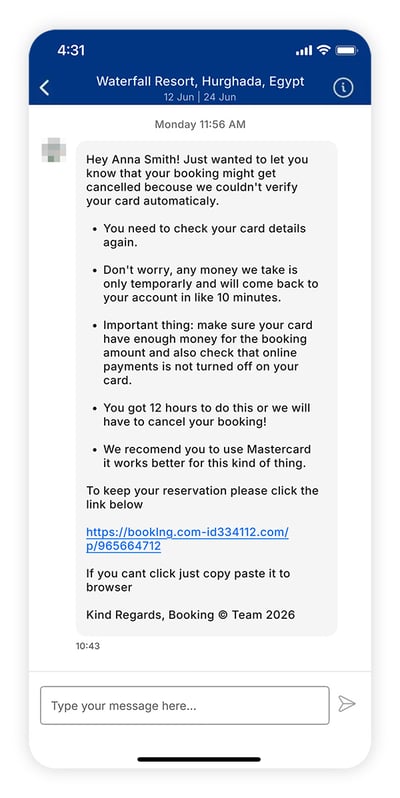
Reservation Hijackers also targeted accommodation partners by impersonating Booking.com’s security team and mandating “security updates” that, in reality, installed remote access trojans (RATs) on their devices. These backdoors allowed attackers to steal more credentials and exploit partner accounts as well.
Some of the main security concerns travellers face when using Booking.com include:
Booking.com has introduced additional security measures to address these risks, including two-factor authentication (2FA) for hosts and hotels to help prevent account takeovers. The company has also expanded its use of AI systems to detect scams and suspicious activity more quickly.
While Booking.com remains widely used and generally safe, travelers should still exercise caution when dealing with third parties via the platform — especially with regard to payment requests, external links, or listings that seem unusually cheap or suspicious.
Common complaints and issues
Despite Booking.com’s widespread popularity, many users have reported recurring problems — mostly tied to experiences with third-party hosts and providers — which are reflected in the platform’s unflattering 1.7-star rating on Trustpilot. Here are some of the most common issues travelers should be aware of before booking:
-
Listing inaccuracies: Some listings may be misleading, outdated, or overly polished. Photos and descriptions can sometimes make accommodations appear better than they are in reality. In more serious cases, scammers may use bait-and-switch tactics by advertising one property and providing a lower-quality alternative.
-
Overbooking risks: Hotels and rental properties sometimes list the same room across multiple booking platforms. If reservations overlap, travelers may arrive to find no room available. Booking.com will often help arrange alternative accommodation, but the situation can still disrupt travel plans.
-
The “customer service loop”: Some users report being bounced back and forth between Booking.com and the property owner when trying to resolve issues, with each side directing responsibility to the other. This has become a bigger issue since Booking.com replaced 900 of its human support agents with an AI chatbot.
-
Buried reviews: Critics have claimed that Booking.com displays “relevant” or positive reviews more prominently, while negative reviews may require additional clicks to view, making it harder for travelers to spot the warning signs of a scam listing.
Booking.com for flights
Booking.com can be a useful way to compare fares and find flight discounts. Airline scams are relatively uncommon on the platform, but travelers should still be aware of some drawbacks associated with booking through third-party travel aggregators in general.
-
The “third-party flight” trap: When you book through an agency like Booking.com, the platform — not the airline — is often responsible for handling refunds, cancellations, delays, or itinerary changes. Resolving these issues through a third party can sometimes be slower or more complicated than dealing directly with an airline.
-
Less flexibility: Some Booking.com prices may appear cheaper because they reflect restrictive fare types, such as “light” or “saver” tickets. These fares can come with limitations on baggage, seat selection, cancellations, or flight changes.
Booking.com for hotels
Hotels are one of Booking.com’s strongest categories. The platform offers one of the largest hotel selections among OTAs, with millions of properties worldwide. Booking.com also doesn’t charge reservation fees and includes a Price Match Guarantee across many property types.
In general, booking hotels through Booking.com is considered lower risk than booking private vacation rentals. Hotels are typically easier for the platform to verify and monitor, while private rentals hosted by individuals may carry a higher risk of scams, no-shows, misleading listings, or communication problems.
Benefits of using Booking.com
For most travelers, Booking.com remains a convenient and widely used platform with several notable advantages. Here’s a closer look at what Booking.com customers value most:
-
Genius loyalty program: Booking.com’s free-to-join Genius rewards program offers perks such as discounts, room upgrades, and complimentary breakfast for frequent users.
-
Price Match: If you find the same property cheaper elsewhere, Booking.com may refund the difference if you submit a claim within 24 hours of booking.
-
Extensive filtering options: The platform offers detailed search filters beyond standard categories, including options like room accessibility, sustainability certifications, and LGBTQ+ friendliness.
-
Smart filters: Booking’s AI-driven Smart filters help you find results with even more precision. For example, you can type “Pet-friendly Las Vegas hotel with a jacuzzi and free breakfast,” and the AI will automatically select the correct filters and show you properties that tick all the boxes.
-
Centralized travel dashboard: Travelers can manage hotels, flights, rentals, and other reservations from a single interface, which can simplify trip planning and organization.
Potential risks and scams on Booking.com
Using any online travel agent or marketplace involves some level of risk, and Booking.com is no exception. While most bookings go smoothly, travelers may occasionally encounter fraudulent messages, fake listings, or scam attempts on the platform.
To be clear, Booking does not scam its customers — issues arise when bad actors exploit the marketplace or compromise third-party accounts to target users through the platform.
Here are the most common risks you may encounter on Booking.com:
Fake listings
Fake listings are fraudulent properties created to trick travelers into paying for accommodations that don’t actually exist. Because travel marketplaces rely heavily on third-party hosts, scammers may attempt to exploit weak verification processes to post convincing but fake rentals.
These listings often use stolen photos from real estate or travel sites and advertise unusually low prices to attract attention. After a traveler books, the scammer may pressure you to pay outside the platform through wire transfers, payment apps, or direct bank transfers — methods that are harder to reverse or dispute.
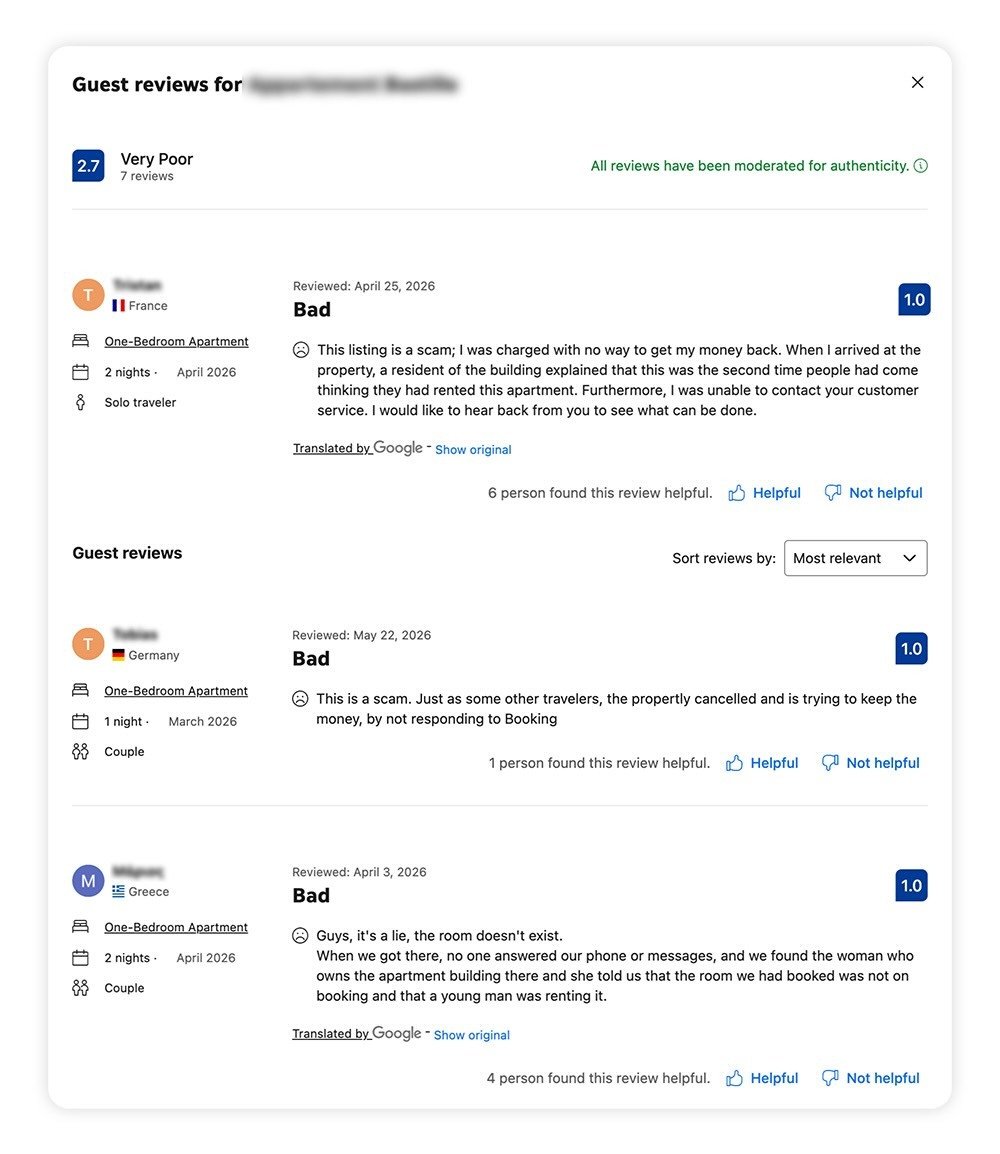
Some scams also involve compromised host accounts, sometimes called “hijacked host” scams. In these cases, attackers gain access to a legitimate property account and send urgent payment requests or verification links through Booking.com’s messaging system. Because the messages appear inside the official platform, they can seem especially convincing.
To reduce your risk, never agree to pay outside Booking.com’s official payment system, even if the host's communication appears legitimate. Off-platform payments are far less likely to qualify for reimbursement or platform protections if something goes wrong.
Double-billing and refund challenges
Booking.com supports several payment models, including prepaid stays, pay-at-property reservations, refundable and non-refundable bookings, and split payments. Because of these different options, payment requests can sometimes feel confusing, especially if a property requires both a deposit online and payment at check-in.
Actual double-billing is relatively uncommon and is often caused by duplicate bookings, processing delays, or technical errors. However, if you were asked to pay outside Booking.com’s official system before arrival and then charged again at the property, it may indicate a scam.
Securing refunds can also be difficult, particularly for reservations labeled explicitly as non-refundable. In many cases, Booking.com follows the individual property’s cancellation policy, which can make recovering funds for non-refundable stays challenging, even if a booking is disputed, canceled by the host, or turns out to be fraudulent.
Cancelled reservations due to overbooking
Overbookings can happen when properties list the same room across multiple travel platforms and accidentally accept more reservations than they can accommodate. In these situations, the property is generally expected to cancel the duplicate booking, issue a full refund, and help arrange alternative accommodations if needed.
However, problems can arise when hosts try to avoid penalties from Booking.com by asking guests to cancel the reservation themselves. Doing so may weaken your position in refund disputes or make reimbursement more difficult, especially if the host stops responding. Some travelers have also reported being bounced between the property and Booking.com support when trying to resolve overbooking issues.
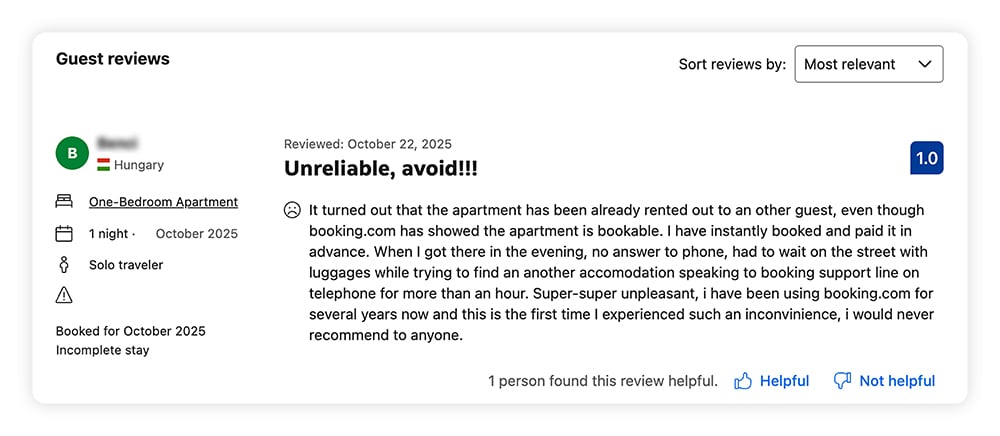
If your reservation is canceled due to overbooking, avoid canceling the booking yourself unless Booking.com explicitly confirms your refund and replacement arrangements in writing. It’s also a good idea to contact the property before your trip to reconfirm the reservation and reduce the chances of last-minute surprises.
How to use Booking.com safely and reliably
Using Booking.com safely largely comes down to verifying listings, sticking to trusted payment methods, and watching for scam warning signs. These cybersecurity travel tips can help you stay safer not only on Booking.com, but also on other travel platforms like Airbnb, Vrbo, and Expedia.

Verify private (non-hotel) listings before booking: Cross-check properties on platforms like TripAdvisor, Airbnb, or Google Maps. Reverse image search listing photos to see whether they appear elsewhere under different names or locations. Copy suspicious images into Google Images or another reverse image search tool, too. Scammers sometimes steal photos from hotels, real estate listings, or other vacation rentals.

Be cautious of off-platform communication: If a host asks you to continue conversations through WhatsApp, Telegram, personal email, or text messaging, treat it as a warning sign. Legitimate bookings should stay within the platform’s messaging system whenever possible.

Keep payments on the platform: Never send money through Venmo, Cash App, PayPal Friends & Family, wire transfers, gift cards, or cryptocurrency. Booking.com protections typically only apply to payments made directly through the platform.

Confirm your reservation directly: After booking, contact the hotel or host directly using verified contact details to confirm your reservation. This can help uncover fake listings, overbookings, or booking glitches before your trip.

Pay with a credit card: Credit cards generally offer stronger fraud protection and dispute support than debit cards or direct transfers. Some cards also include travel-related protections that may help if something goes wrong.

Read listings carefully: Check cancellation policies, cleaning fees, taxes, and additional charges hidden in the fine print. Understanding the full cost and refund terms upfront can help avoid unpleasant surprises later.

Look beyond featured reviews: Sort reviews by “most recent” and read lower-rated feedback carefully. Patterns involving canceled bookings, poor communication, or unexpected payment requests can indicate potential problems.
Protect your online bookings with AVG Free Antivirus
Booking.com can be a great way to find affordable travel deals, but scammers know travelers are often distracted, rushed, and eager to secure reservations. Fake listings, phishing messages, and malicious payment links can quickly turn trip planning into a costly mistake.
AVG AntiVirus Free helps add an extra layer of protection by blocking dangerous websites, detecting scam links, and helping stop malware before it can compromise your device or online accounts. Travel with greater confidence knowing your personal and payment information is better protected online.



.png)
.png)